Celebrate Pi Day with a spoonful of AACT resources!

By AACT on March 9, 2026

Celebrate pi (and pie) with these AACT resources!

  • As Easy As Pie: In this "Whodunnit" style lab, students identify an unknown white powder baked into a pie through physical and chemical properties.
  • ChemMatters: How Does Puff Pastry Rise?: Puff pastry does not incorporate the traditional leavening agents from a pie crust. So how does it rise? Explore the answer in this ChemMatters section.
  • Ideal Gas Law Using Carbon Dioxide: In this demonstration, students observe dry ice sublime while the CO2 gas fills a balloon. Pi is used to calculate the volume of CO2 to use in the ideal gas law equation.
  • ChemMatters: How the Cookie Doesn’t Crumble ...and Other Sweet Chemistry Secrets: It’s no accident that some cookies are crisp and others are soft; that some cookies are flat and others are cake-like. Find out how basic chemical principles are used to make the perfect sweet treat.
  • Did you know? Bohr used pi in his initial calculations of atomic radius. The equation used the constants explained below. 
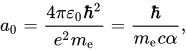
    {\displaystyle a_{0}={\frac {4\pi \varepsilon _{0}\hbar ^{2}}{e^{2}m_{\text{e}}}}={\frac {\hbar }{m_{\text{e}}c\alpha }},}


    • εis the vacuum permittivity constant, which relates the relative density of an electrical field
    • ħ is the reduced Planck constant, which explains the relationship between frequency and wavelength of electrons 
    • me is the mass of an electron
    • e is the charge of an electron
    • c is the speed of light
    • α represents the strength of interaction between electrons.